- May 11, 2026
- Myles Broscoe
- 8:51 pm
CHEFMOD PLATFORM UPDATE | CULINARY DATA INTEGRITY INITIATIVE
Data Precision – and how it helps you get the most out of our comparison tools
How ChefMod is reworking its item database around the standards of the professionals who use it.
At ChefMod, we believe the data behind your purchasing decisions should be as exacting as the standards you bring to every plate. Our team categorizes thousands of items every week across all of our accounts, meaning it’s important that we have robust, up to date methods for organizing what our members buy. That’s the driving principle behind the Culinary Integrity Initiative – a comprehensive, methodical refinement of how products are grouped, labeled, and analyzed across our platform.
This is not a cosmetic update. It is a structural investment in the quality of your tools, built on the understanding that bad data costs real money: in over-ordering, in missed savings, in reports that don’t always reflect what happens in your kitchen. It also guards against inadvisable substitutions, which cost time to switch out or even worse, trust with your teams and customers.
Built Around the Chef’s Perspective
Professional kitchens run on distinctions that matter. The difference between a Wild Chinook salmon and a farmed Atlantic salmon is not a matter of preference — it’s a difference in price point, flavor profile, and the story you’re telling your guests. A loin is not a fillet. A side is not a portion. A whole fish is not a center cut. These are not interchangeable products, and they should generally not be treated as such in a comparison group.
We’re working to make sure our product groupings always reflect these realities. Categories that show an equivalency must match how a professional chef would draw an equivalence. The Culinary Integrity Initiative is improving that, ensuring that when you compare prices, you are always looking at true functional alternatives, meaning products that could genuinely substitute for one another in your kitchen.
A few examples of the distinctions being honored:
- Wild Chinook Salmon vs. Farmed Atlantic Salmon – different species, different fat content, different grains, different cost structures, different menu positioning. These will now live in separate groups.
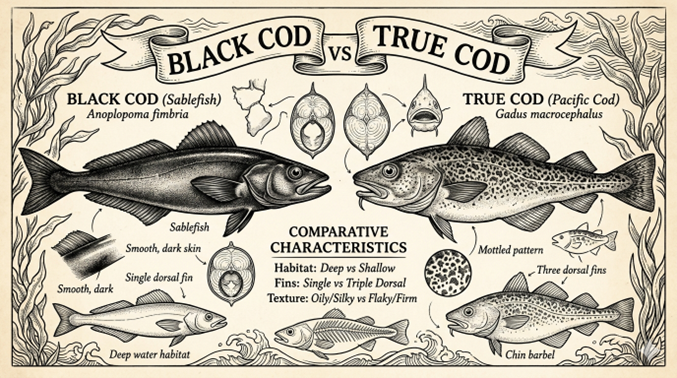
- Black Cod (Sablefish) vs. True Cod – despite the shared word “cod,” these are entirely different fish. Sablefish is oilier, richer, and commands a different market price. They will never share a comparison group when fresh or smoked.
- Loins, Fillets, Portions, and Sides – each cut carries different yields, different prep requirements, and different cost implications and often different ‘value associations’. The system now reflects that.
- Scrod – a term long used loosely in the industry – is a size and age category (typically cod or haddock under 2.5 lbs), not a species. Items previously labeled as scrod are now also identified by their actual species, so you know exactly what’s arriving at your kitchen door.
Why We’re Starting With Seafood
Of all purchasing categories, seafood is where language is most frequently used to obscure rather than clarify. Fish and shellfish have long been sold under a tangle of common names, regional nicknames, trade jargon, and vendor-specific terminology that can make it genuinely difficult to know what you’re buying – or to compare what you paid last month against what you’re being quoted today.
Some of this complexity is inherent to the category. A single species can carry multiple legitimate names depending on the region, the language, and the tradition behind it. But some of it has historically served suppliers more than buyers. When a product description is vague enough to describe multiple different fish, the buyer and end consumer carry the risk.
ChefMod is resolving that ambiguity head-on, starting with a thorough audit of every seafood item in the database. Salmon and shellfish categories are following in subsequent phases, each receiving the same rigorous treatment. Here’s a look at draft versions of the internal documents we’re developing for our data teams. We believe it’s important to be transparent about how our operations work, think of it as an ‘open kitchen’ concept to use a culinary metaphor.
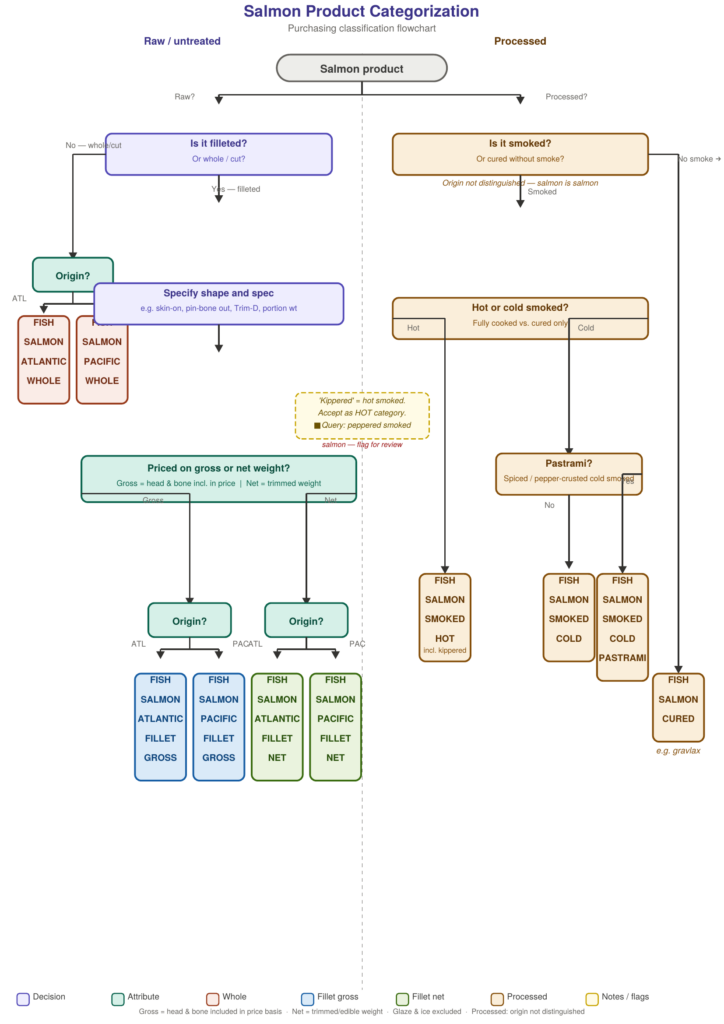
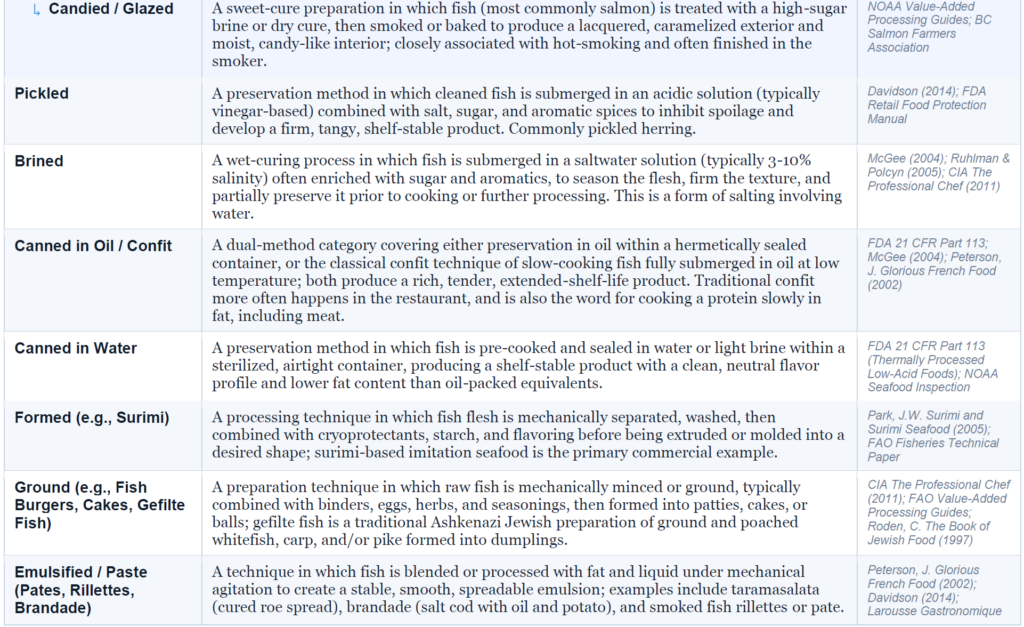
The Cod Project: A Case Study in Precision
Cod was the first major category to undergo full reclassification, and it’s an instructive example of the depth of work involved. What might appear to some on the surface to be a simple product category is, in practice, a complex web of species distinctions, preparation styles, cultural traditions, and different price points. To address this properly, we are building new comparison groups within the cod category.
The Black Cod / True Cod Distinction
The most important separation is between Black Cod and True Cod. These are not the same fish. Black Cod — also known as Sablefish, or Gindara in Japanese culinary tradition – is a deep-water species prized for its exceptionally high oil content, buttery texture, and premium market value. It is a staple of izakaya menus and commands prices that bear no relationship to those of True Cod. Grouping these two fish together in a comparison group could generate misleading data and distort purchasing decisions. They will not share a group on the ChefMod platform.
Cut Integrity Across the Board
Beyond species, the cod reclassification enforces cut integrity throughout. Fillets, loins, and whole fish are each in their own categories. This matters because a loin and a fillet are different products with different yields, different prep requirements, and different per-plate costs. Comparing a loin price against a fillet price is not always useful and can lead to decisions that look like savings on paper but aren’t in the kitchen.
Salted and Dried Preparations: Bacalao, Stockfish, Stoccafisso
Salted and dried cod preparations have their own culinary identity, their own market, and their own pricing logic. Whether labeled Bacalao, Salted Cod, Stockfish, or Stoccafisso – regional names for what is fundamentally the same preparation tradition – these products are now consolidated into a dedicated group that properly reflects their distinctiveness and separates them entirely from fresh or frozen cod categories.
Transparency Across Every Transaction
Better comparison groups are only part of the picture. The Culinary Integrity Initiative also addresses how costs are reported, how weights are communicated, and how units of measure are defined – because clarity at the item level only creates value if it carries through to your analytics.
Your Historical Data, Protected
As duplicate items are consolidated into single, streamlined listings, we are prioritizing the integrity of your purchase history. Our process is designed to merge historical data so that your monthly and annual reports remain accurate and unbroken – and your preferred items remain accessible on your Smart Lists with their full history intact. The cleanup happens in the background; your reports should show a continuous, honest record.
Net Weight vs. Gross Weight: No More (or much less) Guesswork
Pricing for seafood and other variable items explicitly identifies whether a price is based on Net Weight (the usable product after trim and processing) or Gross Weight (the whole item including bones, shells, and trim). This distinction has a direct impact on your actual cost-per-serving, and it will now be clearly labeled on every applicable item. When pulling these items into ezRecipe or your own native system to manage recipes the prices will be more precise.
Catch Weights and Standardized Units
For variable-weight items like fresh seafood, catch weights (average weights per unit) are now clearly documented, allowing the system to calculate estimated total costs with greater precision. Units of measure have been streamlined to three: Each (EA), Case (CS), and Pound (LB). Each is clearly defined so when an item is sold as an Each, you will know exactly what that represents (for example, a 6oz portion).
Supporting Sustainable Choices
Better classification doesn’t just serve your bottom line – it also makes it easier to act on your values. By standardizing species identification and sourcing data, the Culinary Integrity Initiative creates the foundation for integrating Seafood Watch sustainability ratings directly into your purchasing practice.
- Best Choice (Green) — well-managed, responsibly sourced
- Good Alternative (Yellow) — some concerns, but a reasonable option
- Avoid (Red) — overfished or caught/farmed in ways that harm other marine life
These ratings can only be applied accurately when we know exactly what species and sourcing method we’re describing. The groundwork being laid now makes that possible.
A Commitment to Ongoing Quality
Cleaning up the existing database is only part of the commitment. To maintain this level of integrity as new products are added, ChefMod has implemented dedicated review protocols – including regular audits of newly added items to catch and correct categorization errors before they reach your dashboard.
The goal is a platform that stays highly accurate over time, not just at the moment of a one-time cleanup.
This is a big project, it takes painstaking work by lots of eyes and we value our members feedback – whenever you see items that don’t look right, flag them with the wrench icon on an item or reach out directly to let us know.
This is ChefMod honoring your expertise — with tools built to match it.